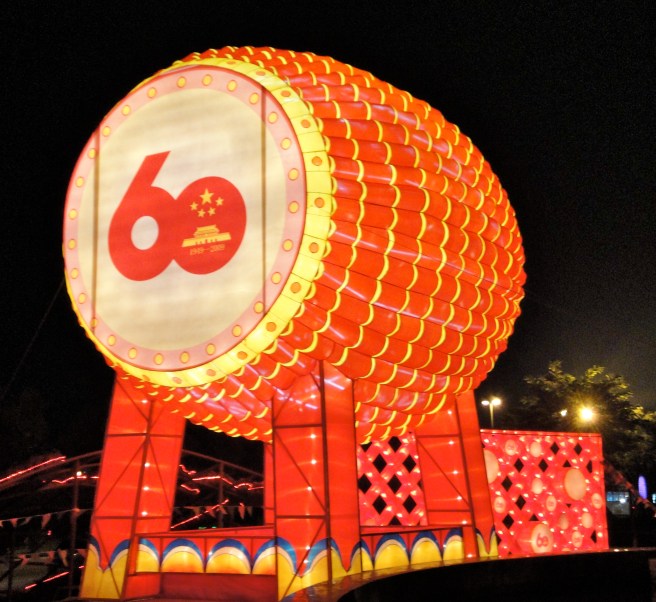
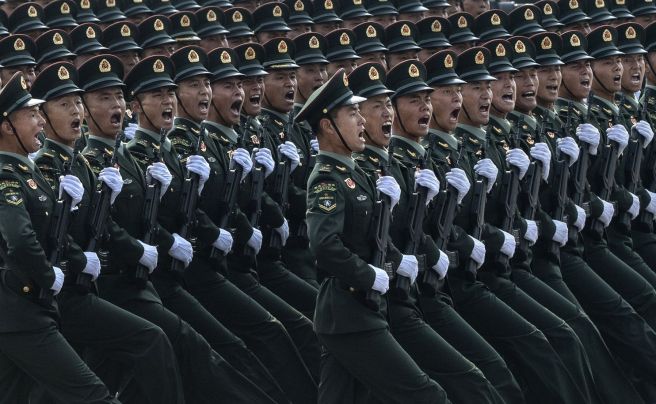
The Communist Party of China (CPC) has turned 70 yesterday. With the biggest military parade ever held in Beijing, showcasing the latest additions of military hardware, China kicks off its 国庆节 (guó qìng jié) ‒ also known as ‘National Day’. It was on 1 October 1949 that Mao Zedong proclaimed the People’s Republic of China. After decades of war and chaos, the country had finally been pacified and reunited under communist rule. At last, China could leave its troubled past behind and start to rebuild.
This is my third National Day while living in China. Watching the 80-minute long parade passing through Tianan’men Square, I was struck by the similarities with the previous celebrations: picture-perfect soldiers marching in typical communist tradition, saluting the supreme leader Xi Jinping who is reminding both his entourage and the rest of the world who is in charge. The whole affair has a certain North Korean vibe to it, especially given the overly enthousiastic crowds that seem to become more ecstatic with every tank that rolls by. Business as usual, you would think.
Compared to the CPC’s 60th birthday, there are also noticable differences. Back in 2009, I was on a two-week language course in Lanzhou, a dusty provincial capital in central China. This was part of my introduction to China during my gap year, which had commenced the previous month. I was staying with a host family of whom only Nancy, the couple’s daughter, could speak English. They were extremely kind and made sure I could enjoy a proper Western breakfast every morning, including coffee (which was a rare find outside the coastal cities). National Day would be the highlight of my visit and the preparations were in full swing. The genuine excitement was palpable, as Nancy was translating her parents’ explanation of what this day means to the Chinese people. I was reminded several times that the upcoming celebrations were even more important than the Olympic games that had been held in Beijing the year before.
Being new to China and its history, I wondered why everyone was placing so much importance on, in the end, just another birthday. Nancy’s father, a mid-ranking government official, gave me an intriguing answer. The promises that were made by the CPC in 1949 had been delivered upon: China had become a strong and confident country again, raising hundreds of millions of people out of poverty and rapidly becoming an economic powerhouse. No longer would China be viewed as the ‘sick man of Asia’; instead, the world would increasingly look to China for providing much needed economic growth and access to its new, innovative markets. Through the achievements and guidance of the Party, the Chinese people could be proud of their country once more.
No longer would China be viewed as the ‘sick man of Asia’; instead, the world would increasingly look to China for providing much needed economic growth and access to its new, innovative markets.
Throughout my travels in China that year, I would encounter this optimism time and again. Sure, life was still hard and prospects could be meager but things were undoubtedly better than before and steadily improving. While having dinner with a Tibetan family on the outer ranges of the Himalayas, the hostess told me they could eat meat every day now, where as children they only had a slice of pork once a month. The CPC had been clever to lay claim (and still does) to these improvements in people’s lives. Everywhere I went there were large banners with slogans stating it was the Party that facilitated this new prosperity. Work hard, obey the Party and your dreams would come true. And for many, they did.
Fast-forwarding to 2019, the same energy is still prevalent. Despite the negative context that surrounds China nowadays ‒ its trade war with the US, the many malinvestments through the Belt and Road Initiative, disputes over territorial claims and human rights, violent anti-government protests in Hong Kong ‒ the future outlook of the country and attitude towards the CPC is for many Chinese a reason to celebrate. One crucial element, however, is often ignored or simply overlooked. That is, the source of the CPC’s success, and with it its legitimacy, is quickly drying up. The Party has undeniably done an incredible job in improving people’s living standards. By opening up its economy and unleashing the entrepreneurial spirit of the Chinese people, China has witnessed unprecedented levels of economic growth.
For all the impressive numbers and endless praise that the CPC bestows upon itself, China has, in essence, simply been playing catch up.
Yet this achievement can be considered low-hanging fruit, given the dire state of the country when communist rule was first established. For all the impressive numbers and endless praise that the CPC bestows upon itself, China has, in essence, simply been playing catch up. The real challenges still lie ahead. How do we distribute all the newly created wealth? What needs to be done to maintain not just economic growth, but equal opportunities for all members of society? Can we safeguard stability while respecting cultural differences? In my view, these questions cannot be sufficiently tackled by China’s current model of development and would ultimately require some kind of reform.
Few would deny the impressive achievements of the CPC in terms of economic growth and poverty alleviation. A united, confident and increasingly prosperous China is a reason to celebrate for both the Chinese and the rest of the world. Now that China is catching up to the developed countries, it is time for less patting on the back and instead focus on the challenges ahead. For the Party to keep partying like it’s 1949, change is inevitable.

 China Hand
One thought on “Party like it’s 1949”