
2019 was a very special year for China and, in particular, the Communist Party of China (CPC). It marked the 70th anniversary of the founding of the People’s Republic of China (PRC) on 1 October 1949 (I have commented on the celebrations here). 2021, however, is considered even more important because, on July 1st, it will be 100 years ago when the CPC was officially founded. The discourse surrounding this historical moment will be predictable: nothing but glory to the Party and not a word about any wrongdoing. Foreign commentators will jump in and point to the excesses of the Party’s rule such as the Great Leap Forward and the Cultural Revolution. Their (mainly) Chinese counterparts will, in turn, be annoyed by the West’s one-sidedness and ignorance of the Party’s achievements. Et voilà, we’re back at where we started.
Moderate voices are of course present on both sides, but often remain muted. That is why I will publish a series of articles about China’s modern political history that intend to bridge the gap between the ‘propagandists’ and the ‘China-bashers’. Before we dig in, a brief explanation of the structure will be helpful. Consisting of three articles in total, the series borrows from the same number of acts employed by magicians: The Pledge, The Turn, and The Prestige. First up is The Pledge, where the audience is presented with something quite ordinary, like a dove. After that comes The Turn: something extraordinary happens; for instance, the dove disappears. Finally, there is The Prestige, the last act in which the illusion reaches its climax by having the dove suddenly reappear. (Those who have seen Christopher Nolan’s film The Prestige will be familiar with this procedure.)
You may ask yourself what on earth a reflection on China’s political history has to do with illusionary tricks. Well, more than it may seem.
You may ask yourself what on earth a reflection on China’s political history has to do with illusionary tricks. Well, more than it may seem. For one thing, it serves as a useful analogy to explain how the political ideology of the CPC developed over time. Without revealing the clue straight away, let us begin with the first act, The Pledge, by going back to early twentieth-century China: a time of chaos, humiliation, revolutions and counter-revolutions. There are two events I would like to highlight in this period. The first event will explain why the ideology of communism took hold, while the second illustrates how communism was able to facilitate the Party’s rise to power. To apply a more Chinese lens, the narrative will be complemented by brief sections from the Concise History of the Communist Party of China (中国共产党读本) compiled by Tang Xiaoju (a dry but useful read).
On July 23, 1921 the CPC was officially founded during its first National Congress in Shanghai. Mao Zedong attended as a delegate from Changsha in rural Hunan province, along with a handful of delegates from other Chinese cities. Although the CPC had little more than 50 members, it had grand ambitions. China was to be transformed from a backward, feudal country into a confident, independent nation based on Lenist-Marxist principles. After decades of foreign occupation with ‘unequal treaties’ − such as the Treaty of Nanking that was signed after the First Opium War in 1842, ceding Hong Kong island to the British − the collapse of the Qing dynasty and enduring chaos, the communist rebels were convinced China had to radically break with its troubled past.
The capitalist system of the Western powers, subsequently implemented by the leaders of the Republic of China, was viewed as inherently exploitative and corrupt, and therefore ultimately unfit for a country like China.
The capitalist system of the Western powers, subsequently implemented by the leaders of the Republic of China, was viewed as inherently exploitative and corrupt, and therefore ultimately unfit for a country like China. Moreover, the 1917 October Revolution in Russia turned the ideas of communism into reality for the first time. In China, the Russian revolution was seen as a vindication of the proletariat over the evil and destructive forces of the West, which were most notably illustrated by the horrors of World War I. This was perceived as “a concentrated expression of the sharp inherent contradictions of the capitalist system”, which pushed Chinese intellectuals “to find a new ideological weapon.”
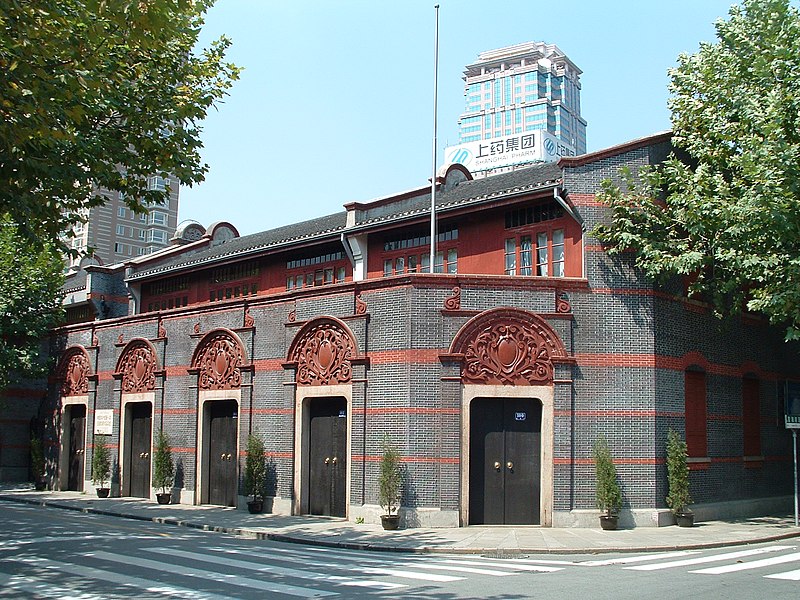
During my Bachelor exchange semester in Shanghai in 2012, I stumbled upon a newly-renovated, somewhat out of place building in Xintiandi, the city’s most sophisticated shopping district. It happened to be the building where the CPC had held its first National Congress in 1921. I was surprised by the modest, artificially old style of the two-story building. Was this really the birthplace of communist China? It looked as if the Party had wanted this place to keep a low profile, just like it did during its first National Congress when the last day was held on a boat out of fear for a police raid. Yet it was here that early ideas about a harmonious Chinese communist society were turned into action.
The Party’s struggle for survival following its establishment was long and arduous. This period is symbolised by the ‘Long March’ that led the revolutionaries on a heroic journey through central China, fighting both their political rivals and the Japanese invaders. In January 1935, the exhausted and demoralized communists arrived in Zunyi, a strategically located town in the southwestern province of Guizhou. So far, the campaign had not gone well. The Red Army was on the defensive and was trying to regroup with other units scattered across the country. Led by the so-called ’28 Bolsheviks’, the army operated along traditional Soviet doctrine with central leadership and a rigid chain of command.
One key reason why the CPC was able to avoid annihilation and eventually establish absolute power, was its intellectual flexibility and relentless pragmatism.
During the first stage of the civil war, Mao’s role in the Party’s leadership was limited. This left him in a relatively strong position to attack the leadership and argue for a new course of action. Instead of focusing on defensive warfare the army should adopt guerilla tactics and rely on support from the masses. Backed by the influential Zhou Enlai, who would later become the first premier of the PRC (for more on Zhou, see here), Mao was able to convince the other Politburo members and generals. The revised strategy proved to be a turning point in the war and cemented Mao’s leadership within the Party.
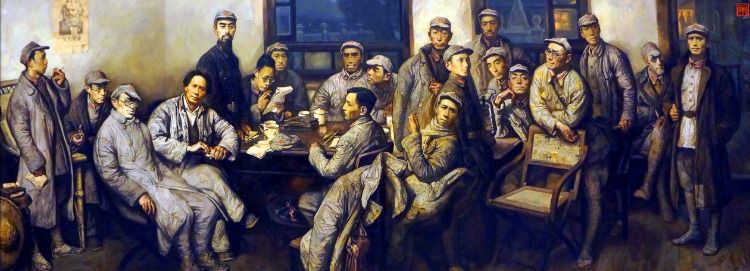
At first glance, the Zunyi Conference site appears rather bleak and unexciting, as so many official places in China do. When I passed through the small city in January 2013 during a trip to Guizhou, I did not expect much when entering the small museum at the edge of a large, empty square. After reading what had taken place there − some of the exhibits included poorly translated English descriptions − my perception changed and the site suddenly became very fitting. Here, in an insignificant town in China’s poorest province, the foundation was laid for not only the future of the Party but for the entire country. A future based on collective spirit, resilience and rejuvenation. One key reason why the CPC was able to avoid annihilation and eventually establish absolute power, was its intellectual flexibility and relentless pragmatism. To the CPC, ideology is but a vehicle and if it does not work, you simply bend it until it does. Classic, Soviet-style communism clearly was not working for Mao and he cleverly developed it into a version with ‘Chinese characteristics’ that did.
A decade and an half after the Zunyi Conference the CPC finally came out on top. Within less than 30 years, it had adopted a foreign ideology and transformed it into a powerful force to expel foreign invaders, crush political adversaries and establish a new nation. This early success concludes our first act, The Pledge. The next act, The Turn, will witness a radical shift in the Party’s strategy and viability.

 China Hand
Great historical overview! I look forward to The Turn.
LikeLiked by 1 person