Part two of this series on China’s modern political history can be characterised as The Turn, the second magician’s act in which something extraordinary happens. As explained in part one, the Pledge-Turn-Prestige structure helps to make sense of the radical, at times spectacular transformation of the Communist Party of China (CPC) since its establishment in 1921. That year at the first National Congress of the CPC, it was decided that communism would be the Party’s ideological weapon in its struggle against both domestic political rivals and foreign aggressors. During the civil war, Mao Zedong cleverly adopted a communist ideology with certain ‘Chinese characteristics’ that not only enabled the Party to win the war but also establish absolute power. The Turn will zoom in on two key figures in the years following Mao’s death in 1976 who facilitated a period of radical reform and unprecedented entrepreneurial spirit.
Firmly relying on the people, the Party carried out a great new revolution of reform and opening up, creating, upholding and developing socialism with Chinese characteristics.
Tang Xiaoju, Concise History of the Communist Party of China
These words introduce the most profound change the People’s Republic of China (PRC) has witnessed in its modern history. In fact, the new course set by the Party during its Third Plenary in 1978 not only changed the country but set the stage for a new world order. The architect of this ambitious plan was Deng Xiaoping. After studying and working in France, Deng joined the CPC in 1924 and was an early supporter of Mao during the civil war. At the Zunyi Conference (described in part one), Deng was promoted and took up key positions within the Party after 1949. Over time, however, Deng fell out of favour with Mao because of his right-leaning political orientation and was purged twice during the Cultural Revolution (1966-1976). Despite this, Deng was able to outmaneuver his critics and political rivals until Mao’s death in 1976 opened the door for Deng to emerge as China’s supreme leader.

In the years that followed, Deng’s first order of business was to restore the economy which was in a dire state due to decades of severe mismanagement. Instead of embarking on enormous and often disastrous economic campaigns such as the Great Leap Forward, Deng introduced a new paradigm for economic development that was based on ‘socialism with Chinese characteristics’ and ‘seeking truth from facts’. Though communist by name, the CPC effectively unleashed market mechanisms and a capitalist mode of production. Starting with the establishment of Special Economic Zones such as Shenzhen and a few other coastal cities in southern China, the spirit of capitalism quickly swept through the rest of country. A whole generation was suddenly allowed, for the first time in their lives, to engage in the pursuit of business and riches.
Though communist by name, the CPC effectively unleashed market mechanisms and a capitalist mode of production.
The decades after Deng’s 1978 reforms have often been described as an economic miracle. Although the scale and pace of the economic development was clearly remarkable and unprecedented, it is debatable whether it should be viewed as special at all. Most, if not all of the spectacular economic growth in the 1980’s and 1990’s can be considered low-hanging fruit. Putting millions of low-skilled people to work in factories churning out cheap goods will increase any country’s gross domestic product. The fact that China has lifted hundreds of millions of people out of poverty within roughly two decades is no mean feat, but not the result of some unique formula. Most Western countries have basically gone through the same process, albeit on a less impressive scale. Moreover, one should take into account the extremely low baseline when evaluating China’s economic growth. Thus, instead of a miracle, China has for the most part been playing a game of long-overdue catch up.
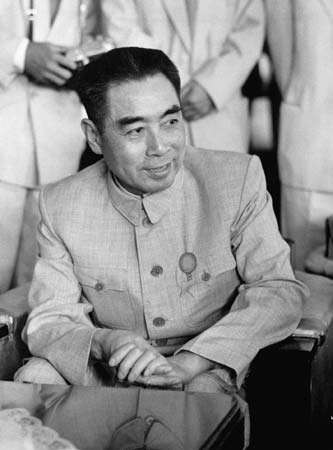
How, then, should we look at China’s economic transformation? In other words, what is The Turn here? The answer should not be found in economics, but in political ideology. The fact that the CPC, after decades of zealous campaigns to establish communism, was able to adopt a completely different and indeed rival ideology is the real moment of awe. When Mao died, the chances that the Party would reinvent itself and set course for a de facto capitalist society were close to nil. It was far more likely that the country would fall into further chaos by the excesses of the Gang of Four. The spirit and arduous work of Deng Xiaoping is surely a key factor in this turn of events. Yet a less well-known but perhaps equally important figure that made this momentous shift possible was Zhou Enlai, who was the first premier of the PRC. While the right-hand man of Mao during the 1950’s and early 1960’s, Zhou became increasingly disillusioned with Mao’s hardline policies. During the Cultural Revolution, Zhou skillfully navigated between lessening the impact of the Red Guards’ horrific acts and ensuring his own (political) survival. Even when he was suffering from cancer and was denied treatment by Mao, Zhou pushed for the adoption of the Four Modernizations that laid the groundwork for the country’s economic rise.
China’s metamorphosis that started in the late 1970’s has dramatically changed the country and has shifted the global balance of power firmly towards the East. It is not, however, strictly an economic miracle. The true transformation took place on an ideological level, empowered by two men − Deng Xiaoping and Zhou Enlai − who stood up against the fanaticism within the Party and were able to lead their country towards a brighter future. This is our Turn. To explain how exactly they accomplished this has been the subject of many books, and the aim of this article is to provide a mere introduction. In the final part, The Prestige, we will see a return of communist fervour and authoritarianism.

 China Hand
Thank you for your analysis, and for acknowledging “the Red Guards’ horrific acts” during the Cultural Revolution.
LikeLiked by 1 person