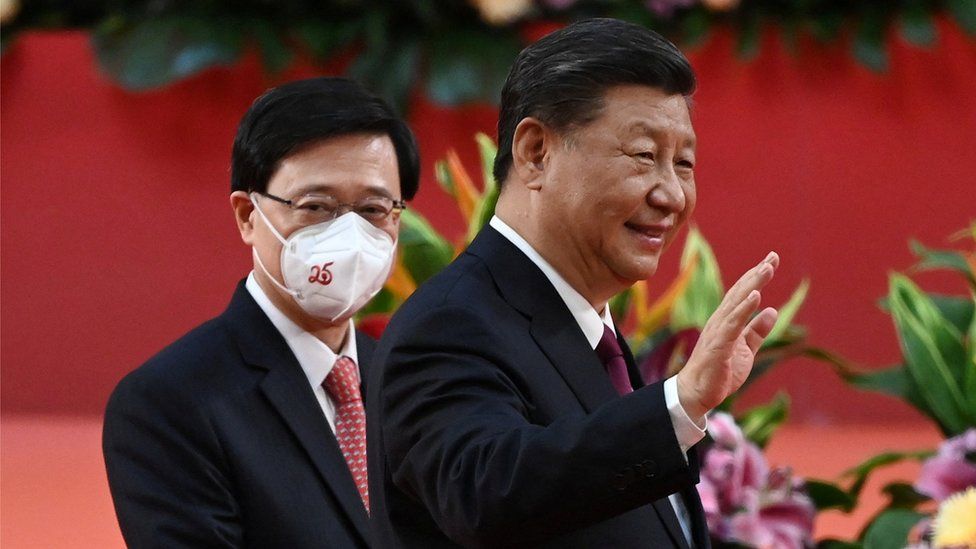
During Hong Kong’s National Day on July 1st, the visiting Chinese president Xi Jinping proclaimed the “beginning of true democracy” in Hong Kong after the mainland regained formal control over the territory exactly 25 years ago. In a venue closed for the public and journalists, after having deployed a huge security force, these words conveyed a chilling message to the world. To most Western spectators, this is a confusing, perhaps even silly statement. By referring to “true democracy”, Mr. Xi not only suggests the Communist Party of China (CPC) has implemented a democratic system in Hong Kong, but also that only China understands the real meaning of democracy. When I read about Mr. Xi’s speech, I could feel my head shaking from left to right. Surely, nobody can take this claim seriously. Or is there more to it?
To get an idea of what “true democracy” means for the CPC, I came across the white paper with the inauspicious title Democratic Progress Under the Framework of One Country, Two Systems that was released by the central government at the end of last year. Officials often refer to this document to justify the increasing influence of the mainland in Hong Kong affairs. With uncharactistic explicitness, the clue of the 60-page document became immediately clear by looking at the table of content:
- Under British Colonial Rule There Was No Democracy in Hong Kong
- The Return of Hong Kong to China Ushered in a New Era for Democracy
- The Central Government is Committed to Developing Democracy in Hong Kong
- Anti-China Agitators Undermine and Disrupt Democracy in Hong Kong
- Development of Democracy in Hong Kong Is Back on Track
- The Prospects Are Bright for Democracy in Hong Kong
After reading through the paper, it was very tempting to take on each of the above claims from a typical Western point of view. All six of the claims could easily be debunked by attacking the concept to democracy used, which is simply false and does not support the conclusions drawn. Although this would have been a somewhat enjoyable exercise, I felt it would not add much to the debate. After all, I would just be another foreign wiseguy pointing out that China is not a democratic country. Instead, I wanted to find out more about how the CPC, and parts of China’s academia, interprets the democractic concept that underpins public policy, both in Hong Kong and on the mainland. What defines democracy in the eyes of the Party? To what extent is it different from its Western version? And can both versions co-exist, or can there only be one?
The One Country, Two Systems white paper is a typical application of the concept of democracy with ‘Chinese characteristics’. While the paper shows how the CPC uses democracy to justify its recent policies in Hong Kong — particularly the National Security Law that was implemented in 2020 — it does not really explain what the authors mean with democracy in the first place. So, I looked up another government white paper with the even more inauspicious title China: Democracy That Works (Yes, this is what the paper is actually called.). In the introduction, the paper introduces the concept of “whole-proces people’s democracy”:
Whole-process people’s democracy integrates process-oriented democracy with results-oriented democracy, procedural democracy with substantive democracy, direct democracy with indirect democracy, and people’s democracy with the will of the state. It is a model of socialist democracy that covers all aspects of the democratic process and all sectors of society. It is a true democracy that works.
China: Democracy That Works
From this definition, we can deduce that whole-process people’s democracy tries to take a holistic approach, integrating the various forms of democracy that purportedly exist. Where Western commentators tend to focus on certain key aspects of democracy, such as the ability to stand for public office and engage in free elections, whole-process people’s democracy integrates many different democractic aspects. For instance, the combination of local elections with national state power. While democratic procedures are important, (economic) results matter just as much, if not more. Since the Party embodies the will of the people, its system of governance can therefore be charactised as a democracy. Whole-process people’s democracy is simply the best of all (democratic) worlds.
To assess China’s political system “against a single yarstick” (i.e., the Western interpretation of democracy with a multi-party system and free elections) would, ironically, be “undemocratic”.
According to the white paper, “there is no fixed model of democracy; it manifests itself in many forms”. Whole-process people’s democracy incorporates, to put it simply, aspects of both Western and Chinese democracy. At the same time, one cannot reduce whole-process people’s democracy to a single, concrete definition. Thus, the concept of democracy becomes fluid: it has many forms, can be interpreted in multiple ways and is subject to constant change. To assess China’s political system “against a single yarstick” (i.e., the Western interpretation of democracy with a multi-party system and free elections) would, ironically, be “undemocratic”.
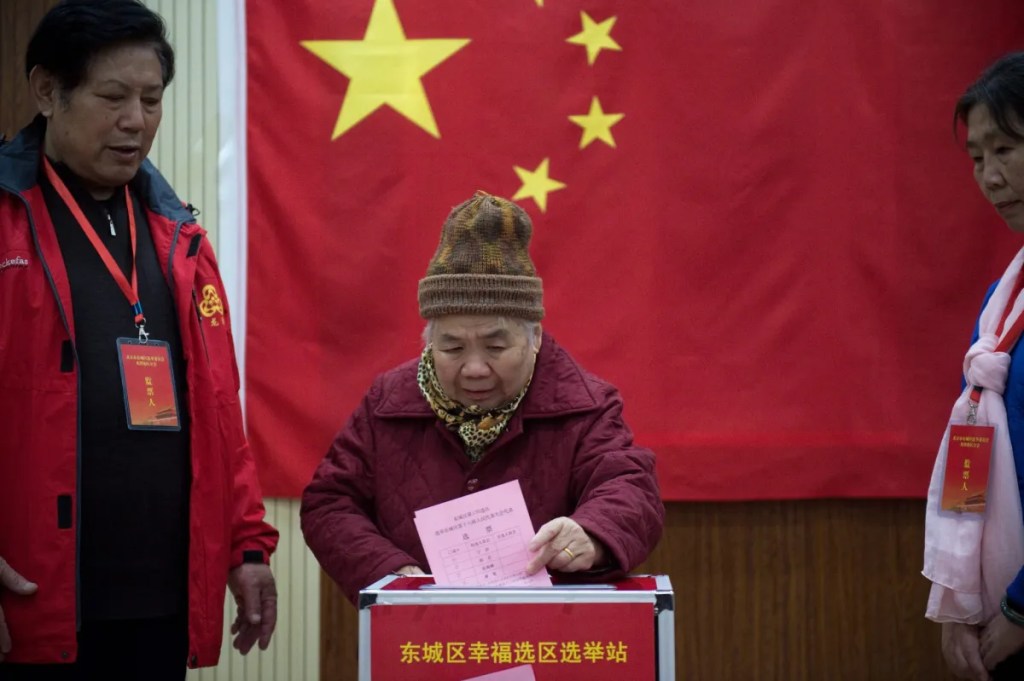
Having defined what democracy means from the Party’s perspective, whole-process people’s democracy differs from its Western version in the sense that the former incorporates aspects of the latter as it does with all the other democratic versions. From this, one could argue that the Western concept of democracy is only one part of the story. According to the authors of the white paper, it is too narrow and unable to cater to China’s “realities”. What these realities actually are, however, remains unclear. A safe assumption would be that China is an ancient, complex civilization that requires a strong state to lead its people. Given its huge size and cultural diversity, implementing the Western version of democracy would lead to chaos. China’s so-called uniqueness in this regard invalidates the democractic rules and procedures that most countries in the West are accustomed to.
Yet in representing everything, whole-process people’s democracy ends up meaning nothing.
Does whole-process people’s democracy have any validity, then? Party officials are keen to refer to China’s unique status and history when confronted with questions around its mode of governance. Though the country’s long and tumultuous history does lend itself to explain the emergence of a centralised, authoritarian state with very few genuine democractic processes, it is by no means a justification. In other words, China’s often difficult past does not justify its current political system. Knowing this, the Party has tried to reinvent the concept of democracy, bending its definition to serve its objective as if redirecting a river to control its natural current. Yet in representing everything, whole-process people’s democracy ends up meaning nothing. The forms of democracy that whole-process people’s democracy attempts to integrate are incompatible at best. Worse, it is unclear how each of the included forms are interpreted, resulting in some sort of meta-definition that is impossible to substantiate and apply to any real-world context.
Many would agree that China is indeed different — perhaps even unique — and advocating a Western version of democracy is not (yet) very effective. However, it would be a mistake to claim that the Party has a monopoly on “true democracy” (interpreted as whole-process people’s democracy). This term is ill-defined and excessively broad, which ends up being meaningless. It would be welcome if Mr. Xi, along with China’s political and academic community, spent less time muddling the concept of democracy and started to outline a policital system that can truly account for China’s realities.

 China Hand
Perhaps the measure of any democracy should be how much freedom it genuinely creates in a community. Many thanks for your post!
LikeLiked by 1 person
wow!! 63Zhou Enlai, remember the name
LikeLike